
Having thousands of social media followers on Instagram, Facebook, LinkedIn, TikTok, or another platform can look impressive. But a large audience does not automatically mean more sales. A business can receive hundreds of likes, comments, views, and shares while still struggling to generate enquiries or purchases.
The real value of social media followers comes from what happens after someone follows your account.
Your goal should not simply be to collect more followers. It should be to build a clear journey that takes the right people from discovering your brand to trusting you, considering your offer, making a purchase, and eventually becoming repeat customers.
Research and current industry guidance consistently emphasize that social media followers represent interest rather than guaranteed buying intent. Conversion depends on factors such as trust, relevance, social proof, clear calls to action, and how easy you make the buying process.
This guide explains how to build that journey step by step.
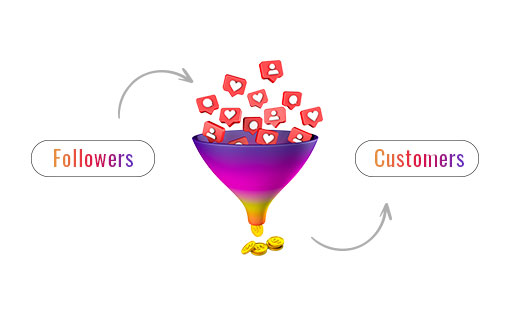
Why Social Media Followers Do Not Automatically Become Customers
One of the biggest mistakes businesses make is assuming that every social media followers is ready to buy.
Someone may become social media followers because they enjoyed a Reel, found a helpful tip, liked your brand personality, or simply wanted to see more of your content. That does not necessarily mean they are ready to purchase.
Think about the difference between these two actions:
Following: “I am interested in what you share.”
Buying: “I trust you enough to spend money with you.”
There is a gap between these two decisions.
Your social media strategy needs to close that gap.
A useful conversion journey looks like this:
Discover → Follow → Engage → Trust → Consider → Enquire → Purchase → Repeat
Every stage needs a different type of content and communication.
For example, a skincare brand might attract someone with educational content about dry skin. The person then follows the account, watches product demonstrations, reads customer reviews, asks a question through DM, and eventually purchases a product.
The sale does not happen because of one post. It happens because several touchpoints gradually build trust and reduce uncertainty among social media followers.
1. Attract the Right Audience, Not Just a Bigger Audience
Before trying to convert social media followers, make sure you are attracting people who could actually become customers.
A follower who has no interest in your product or service has little commercial value.
For example, suppose you run a digital marketing agency for small businesses. A viral post about a general motivational topic may attract thousands of people, but those followers may not be business owners or decision-makers.
Instead, content such as:
- “5 SEO mistakes small businesses make”
- “How to get your first 100 website visitors”
- “Digital marketing checklist for local businesses”
- “How much should a small business spend on marketing?”
is more likely to attract people who have a genuine business problem.
Create an Ideal Customer Profile
Define:
- Who you want to reach
- What problem they have
- What they are trying to achieve
- What prevents them from buying
- What motivates them
- What questions they ask before purchasing
Once you understand your audience, your content becomes more specific.
Specific content attracts more relevant people, and relevant people are easier to convert.
2. Optimize Your Social Media Profile for Conversions
Your profile is often the first place someone visits after discovering your content.
If your profile does not clearly explain what you offer, you may lose potential customers before they even explore your products or services.
A conversion-friendly profile should answer three questions quickly:
Who are you?
What do you offer?
What should I do next?
Write a Clear Bio
Avoid vague descriptions such as:
“Helping you live your best life.”
Instead, make the value clear.
For example:
“Helping small businesses generate more leads through SEO and social media marketing.”
This immediately communicates the audience, service, and benefit.
Use Your Link Strategically
Do not automatically send every visitor to your homepage.
If a social post discusses a particular service, product, guide, or offer, the link should ideally take visitors to a relevant destination.
Reducing unnecessary steps can make the path to conversion easier.
Pin Your Best Conversion Content
Consider pinning:
- A product or service introduction
- A customer success story
- A frequently asked question
- A strong testimonial
- A “Start Here” post
This creates a mini sales journey directly on your profile.
3. Create Content That Moves People Toward Buying
Not every post should directly sell your product. Not every social media followers comes to buy
If every piece of content says “Buy now,” followers may stop paying attention.
At the same time, if you only provide educational content and never mention your offer, people may not realize that you can solve their problem commercially.
A balanced content strategy should include different content purposes.
Educational Content
Teach your audience something useful.
Examples:
- Tutorials
- Checklists
- How-to guides
- Mistake-based content
- Industry tips
- Explanations
Educational content demonstrates knowledge before asking people to spend money.
Problem-Solution Content
Identify a problem and explain how your product or service solves it.
For example:
“Struggling with dull skin? Here are three common causes—and how to build a simple skincare routine.”
The product can then naturally become part of the solution.
Demonstration Content
Instead of simply saying that your product works, show it.
Demonstrations can include:
- Product tutorials
- Before-and-after results
- Screen recordings
- Service processes
- Product comparisons
- Real-life use cases
Showing the process helps potential customers understand what they are actually buying.
Behind-the-Scenes Content
People often want to know the people and processes behind a brand.
You could show:
- How a product is made
- How an order is packed
- How your team works
- How a service is delivered
- How you solve customer problems
This can make the brand feel more transparent and human.
4. Build Trust Before Asking for the Sale
Trust is one of the biggest differences between social media followers and someone who buys from you.
A follower may like your content but still have questions:
- Is this product genuine?
- Will this service actually work?
- Is the company reliable?
- What happens if I have a problem?
- Are other customers satisfied?
- Is the price worth it?
Your content should answer these questions before the customer has to ask.
Use Customer Testimonials
Instead of saying:
“We provide the best service.”
Show customers explaining what they achieved.
A strong testimonial can communicate:
Problem → Solution → Experience → Result
This is much more persuasive than a generic promotional statement.
Use User-Generated Content
User-generated content can include:
- Customer videos
- Product photos
- Reviews
- Unboxing videos
- Customer stories
- Social posts featuring your product
UGC provides evidence from people who have actually experienced your product or service.
Show Real Results
If you have measurable outcomes, explain them honestly.
For example:
“After redesigning the landing page, the business received more enquiries from the same traffic.”
Avoid making unsupported claims or promising guaranteed results.
Trust grows when your content is specific, transparent, and realistic.
5. Turn Engagement Into Meaningful Conversations
Likes from social media followers are useful, but conversations can reveal their buying intent.
Pay attention when someone:
- Asks about price
- Asks about availability
- Requests a product recommendation
- Asks how your service works
- Comments about having the problem you solve
- Replies to a Story
- Sends a DM
These interactions can indicate that the person is moving beyond awareness.
Respond to Comments
If someone asks a genuine question, answer it clearly.
For example:
Customer: “Does this service work for new businesses?”
Instead of:
“Yes! DM us.”
Try:
“Yes. We work with new businesses by first identifying their target audience, then building a practical content and lead-generation strategy. If you tell us what type of business you run, we can suggest where to start.”
The second response provides value while opening the door to a conversation.
6. Use DMs as a Sales Conversation, Not a Sales Pitch
Direct messages can be especially useful for social media followers who need personalized information before making a purchase.
However, avoid immediately sending a long sales pitch.
Start by understanding the person’s situation.
A simple conversation can follow this structure:
Ask → Understand → Recommend → Answer objections → Give next step
For example:
Customer: “How much does your social media management cost?”
Instead of immediately sending a price list, you could ask:
“Sure. What type of business do you run, and which platforms are you currently using?”
Now you have context.
You can recommend a suitable service instead of sending a generic offer to everyone.
Use Automation Carefully
Automated replies can help with frequently asked questions, lead collection, and initial responses.
But automation should not replace human communication when a customer has a complex question or is close to making a purchase.
The goal is not to automate every conversation.
The goal is to respond efficiently while keeping the customer experience useful and personal.
7. Use Strong Calls to Action
One of the simplest ways to convert social media followers into customers is to tell people exactly what you want them to do next.
Weak CTA:
“Let us know what you think.”
Stronger CTA:
“DM us ‘SEO’ and we’ll send you the beginner’s checklist.”
Different goals require different CTAs.
For Engagement
- “Tell us your biggest challenge.”
- “Which option would you choose?”
- “Save this for later.”
For Lead Generation
- “Download the free guide.”
- “DM us ‘GUIDE’ to receive it.”
- “Book a free consultation.”
For Sales
- “Shop the collection.”
- “Order today.”
- “Explore the product.”
For Service Businesses
- “Book your consultation.”
- “Request a quote.”
- “Send us a message to discuss your requirements.”
The CTA should match the user’s stage in the buying journey.
Someone discovering your brand for the first time may not be ready to purchase, while someone asking about price may be ready for a direct sales CTA.
8. Give Followers a Reason to Take Action
Sometimes social media followers are interested in your product but keep delaying their purchase.
A relevant offer can help them make a decision.
Possible incentives include:
- Limited-time discounts
- Free trials
- First-purchase offers
- Free consultations
- Product bundles
- Early access
- Exclusive content
- Free samples
However, do not create artificial urgency.
If you say an offer ends tonight, it should actually end tonight.
Trust is more valuable than a single transaction.
9. Make the Buying Process Simple
You can create excellent content for social media followers and still lose potential customers if the purchasing process is difficult.
Imagine this journey:
Post → Profile → Link → Homepage → Search → Product page → Create account → Checkout
Every additional step can create friction.
Instead, try to make the journey more direct:
Post → Relevant product/service page → Purchase or enquiry
For example, if you promote a particular product in an Instagram Story, the destination should ideally take the visitor directly to that product rather than a generic homepage.
For service businesses, the same principle applies.
A person clicking “Book a Consultation” should arrive at a page where they can understand the service and schedule the next step without unnecessary searching.
10. Use Social Proof at the Right Moment
Social proof becomes particularly valuable when social media followers are considering whether to buy.
Different types of proof can serve different purposes.
Reviews
Useful for showing overall customer satisfaction.
Testimonials
Useful for explaining the customer’s experience.
Case Studies
Useful for demonstrating a problem, process, and outcome.
UGC
Useful for showing authentic product experiences.
Expert Content
Useful for demonstrating knowledge and credibility.
Do not simply collect testimonials and hide them on a website page nobody visits.
Bring relevant proof into your social content.
For example:
“Here is how one customer solved X problem using our service.”
Then explain what was done and what changed.
This combines expertise with evidence.
11. Adapt Your Strategy to Each Platform
A common mistake is posting the same content everywhere without considering how social media followers behave differently on each platform.
Focus on:
- Reels
- Stories
- Carousels
- DMs
- Testimonials
- Product demonstrations
- Creator content
Instagram can be particularly useful for visual discovery and relationship building.
Consider:
- Groups
- Community discussions
- Reviews
- Educational posts
- Local business content
- Offers
For B2B businesses, focus on:
- Industry insights
- Case studies
- Professional expertise
- Customer problems
- Thought leadership
- Lead-generation content
TikTok
Short-form educational, entertaining, demonstrative, and product-focused content can help businesses reach new audiences.
YouTube
Use longer-form content to answer complex questions, demonstrate expertise, explain products, and build deeper trust.
The important point is not to copy and paste the same strategy everywhere.
Match the content and conversion path to the platform and audience.
12. Move Valuable Relationships Beyond the Platform
Social platforms are excellent for discovery and engagement, but businesses should avoid relying entirely on social media followers and rented audiences.
A platform controls its algorithm, distribution, and features.
Where appropriate, encourage interested people to take an action that creates a more direct relationship with your business.
This might include:
- Email subscriptions
- Consultation bookings
- Website accounts
- Product purchases
- Lead forms
- Memberships
For example, a business could offer:
“Get our free 10-point social media checklist.”
The visitor provides an email address and receives the resource.
Now the business can continue providing useful information outside the social platform.
This is particularly valuable for businesses with longer buying cycles.
13. Measure Customers, Not Just Followers
Follower growth is easy to see, but it does not tell the whole story.
A business should also monitor:
- Profile visits
- Engagement
- Link clicks
- Website sessions
- Leads
- DM enquiries
- Bookings
- Purchases
- Conversion rate
- Revenue
- Repeat purchases
Suppose Account A has 50,000 followers but generates 20 customers.
Account B has 5,000 followers and generates 80 customers.
Account B may have a much more valuable audience.
This is why social media measurement should connect activity with business outcomes.
Current conversion-focused guidance recommends measuring clicks, leads, conversions, and customer value rather than relying only on the number of social media followers.
Track Where Customers Come From
Use tracking links, campaign names, analytics, and CRM records where appropriate.
For example, you could create separate campaigns for:
- TikTok
- Influencer campaigns
This helps you identify which channels and campaigns are actually contributing to sales.
14. Test Instead of Assuming What Works
There is no universal conversion tactic that works for every business or all social media followers.
A discount may work well for an ecommerce brand but weaken positioning for a premium consulting company.
A long educational video may work for a B2B service but not for a product that requires only a simple purchase decision.
Therefore, test different:
- Content formats
- Headlines
- CTAs
- Offers
- Landing pages
- Creatives
- Posting themes
- DM approaches
For example, test:
CTA A: “Learn more”
against
CTA B: “Book your free consultation”
Then compare meaningful outcomes rather than just likes.
The purpose of testing is to learn what moves your particular audience closer to purchase.
15. Avoid These Common Conversion Mistakes
Mistake 1: Chasing Follower Count
A bigger audience is not automatically a better audience.
Mistake 2: Selling in Every Post
Constant promotion can make your content feel repetitive and reduce engagement.
Mistake 3: Never Selling
The opposite problem is also common. If you never explain what you sell, interested people may not know how to buy.
Mistake 4: Using Weak CTAs
If followers do not know what to do next, many will simply scroll away.
Mistake 5: Ignoring DMs
A customer asking a buying question is an opportunity for a conversation. Slow or generic responses can cause that opportunity to disappear.
Mistake 6: Making Unsupported Claims
Do not use fake testimonials, exaggerated results, or misleading scarcity.
Mistake 7: Measuring Vanity Metrics Only
Views and likes can provide useful signals, but they should not be the only measures of success.
Mistake 8: Making Checkout Difficult
A complicated buying process can undo the work your content has already done.
16. A Simple Follower-to-Customer Conversion Framework
If you want a simple system to implement, use this seven-step framework:
Step 1: Attract
Create content around the problems and interests of your ideal customer.
Step 2: Engage
Use comments, Stories, questions, polls, and conversations to understand what your audience needs.
Step 3: Educate
Provide useful information that demonstrates your knowledge.
Step 4: Build Trust
Use testimonials, reviews, UGC, case studies, demonstrations, and transparent communication.
Step 5: Create Intent
Show how your product or service solves a specific problem.
Step 6: Convert
Give people a clear CTA and an easy path to purchase, book, enquire, or sign up.
Step 7: Retain
Continue communicating with customers after the first purchase.
Ask for feedback, provide useful information, introduce relevant products, and create reasons for customers to return.
This turns social media from a publishing channel into a customer journey.
Frequently Asked Questions
How do you turn social media followers into customers?
You turn social media followers into customers by building a clear journey from attention to trust and then purchase. Use relevant content, social proof, clear CTAs, personalized conversations, compelling offers, and a simple buying process.
Why do I have many followers but few customers?
Your social media followers may not match your target market, or your content may create engagement without purchase intent. Other problems can include weak CTAs, insufficient trust, unclear positioning, poor follow-up, or a complicated checkout process.
How many followers do you need to start getting customers?
There is no fixed number. A small audience of highly relevant social media followers can generate more sales than a large audience with little interest in your offer. Audience quality and buying intent matter more than follower count alone.
What type of content converts best?
Content that addresses real customer problems, demonstrates expertise, shows products in use, answers objections, and provides credible proof can help social media followers move closer to making a purchase. The best format depends on the audience and industry.
Are discounts necessary to convert followers?
No. Discounts are only one way to convert social media followers into customers. Education, social proof, product demonstrations, exclusive access, free consultations, guarantees where appropriate, and strong customer experiences can also encourage purchases.
Should I sell directly through social media?
It depends on your business and customer journey. For simple products, social commerce can help social media followers purchase more easily. For complex or high-value services, sending them to a consultation, lead form, or detailed landing page may be more appropriate.
Final Thoughts
Turning an audience into customers is not about posting more often or chasing a larger follower count.
It is about building a system that connects attention with action.
Start by attracting the right social media followers. Make your profile clear. Create content that educates and demonstrates your expertise. Build trust through genuine customer proof. Use conversations and DMs to understand buying needs. Give people a clear next step, remove unnecessary friction, and track what actually contributes to revenue.
Most importantly, remember that not every follower needs to buy immediately.
Some people need education. Others need proof. Some need a conversation. Others are already ready to purchase.
When your content recognizes these different stages, your social media strategy becomes much more effective.
The ultimate goal is not simply to have more people following your brand.
It is to build an audience that trusts you, understands your value, buys from you, and wants to come back.
For SEO, keep the article genuinely useful and people-first rather than inserting the keyword unnaturally. Google’s guidance emphasizes helpful, reliable content created for people, with appropriate attention to experience, expertise, and trust.